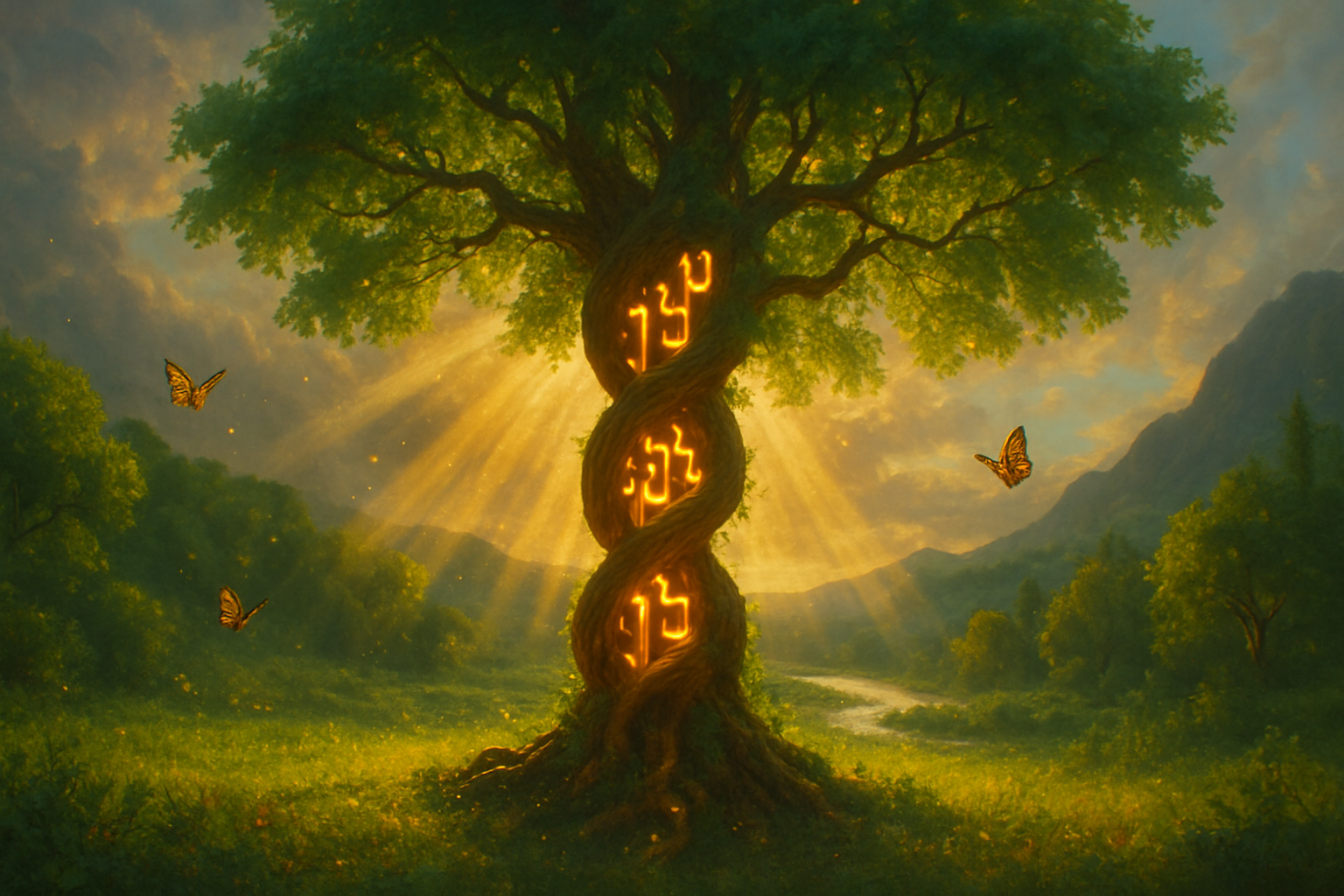
If the Torah is the source code of biology, the source should be findable inside the text. The search has a method.
If the Torah is the schema the universe was compiled from — the claim Pillar II rests on — then biology is one of the places the schema should be most directly readable. The body's translation system uses an alphabet of twenty‑two symbols (twenty amino acids plus two special‑case codons) and a script that already does letter‑by‑letter mapping. The Torah's alphabet is twenty‑two letters. The shapes match too cleanly to ignore.
GeneSys is the program that follows that observation to its conclusion: look for a sequence inside the Torah which, decoded through the right key, becomes a biological sequence that does something measurable. If found, the program is non‑coercive evidence of divine authorship. If not found, the search itself produces value: a corpus, a methodology, and a community willing to look.
Stated as plainly as possible: the Torah contains, in encoded form, biological sequences. The encoding is deliberate, not accidental. The encoding is designed to be findable by a civilization that has both genetic literacy and computational capacity — i.e., this one — and not before. The findability is what the tradition has been pointing at when it speaks of the Torah being "scrambled out of its original order, lest a keen student discover the way to revive the dead" (R. Elazar).
If the hypothesis is correct, three things follow. First: the Torah is provably non‑human. Second: human biology is provably designed, not random. Third: the decoded sequence has practical applications — at the conservative end, medical breakthroughs; at the speculative end, the kind of upgrade the tradition associates with the Tree of Life.
You don't need to believe this to look. You only need to think the look is worth doing.
A cube, a permutation, and a key. The proposed method that turns a chunk of Torah into something a sequencer can read.
The proposed cipher has three components. None of them are arbitrary. Each comes from a place in the tradition that has already been pointing at this question.
The Hebrew alphabet has 22 base letters and 5 final forms — 27 total. 27 is 3³ — a perfect cube. The first step of the cipher arranges the 27 letters as a 3×3×3 cube, an object the kabbalistic tradition has independently spent centuries thinking about.
The cube is then traversed in an order derived from the digits of Pi. Pi is the universe's most prominent transcendental constant — the number you cannot escape and cannot derive. Using it as the permutation key is making the cipher dependent on the same number physics depends on. The two should not be independent.
The Mezuzah scroll is the candidate key text. It carries the large Ayin and Dalet that spell עד (witness); 23 letters span between them, matching the 23 chromosome pairs. The hypothesis: the Mezuzah text is not just a religious affirmation. It is the positional reference the rest of the cipher anchors against.
If any of this is right, it isn't right by accident. It's right because the design intended to be found at exactly this resolution of tools.
A positive result has a clear definition: a sequence extracted from the Torah, through the documented cipher, that when expressed through standard mRNA‑to‑protein translation produces a protein with a measurable, characterizable, replicable biological effect. The criterion is deliberately strict. The point is not to be impressive. The point is to be auditable by anyone willing to redo the work.
The replication path is built in. The cipher is documented end to end. The source text is open. The search software is open source. The biological assay is standard. Anyone with a sequencer, a synthesis lab, and a long weekend can re‑run the entire pipeline. That is the only kind of result worth publishing for this kind of claim.
One technical note. The hypothesis is provable but not falsifiable in the strict Popperian sense. Failure to find a sequence with the current cipher does not prove there is no sequence; it proves the current cipher isn't the right one. The search space of possible ciphers is large. The search may take a long time. It may take generations.
That is acceptable. The project's value does not depend on a result by any particular date. The methodology produces by‑products that are valuable even if the central result never lands: an open corpus of Torah text aligned to biological sequence, an open library of cipher‑search techniques, a community of researchers at the intersection. The hypothesis is the engine. The by‑products are the fuel.
If it is found, the world changes. If it isn't, the search built tools the next searcher needs. Both endings are productive.
GeneSys needs three things, and is actively looking for collaborators in each:
If you work in any of these fields and the project interests you, get in touch.
Email · join the search