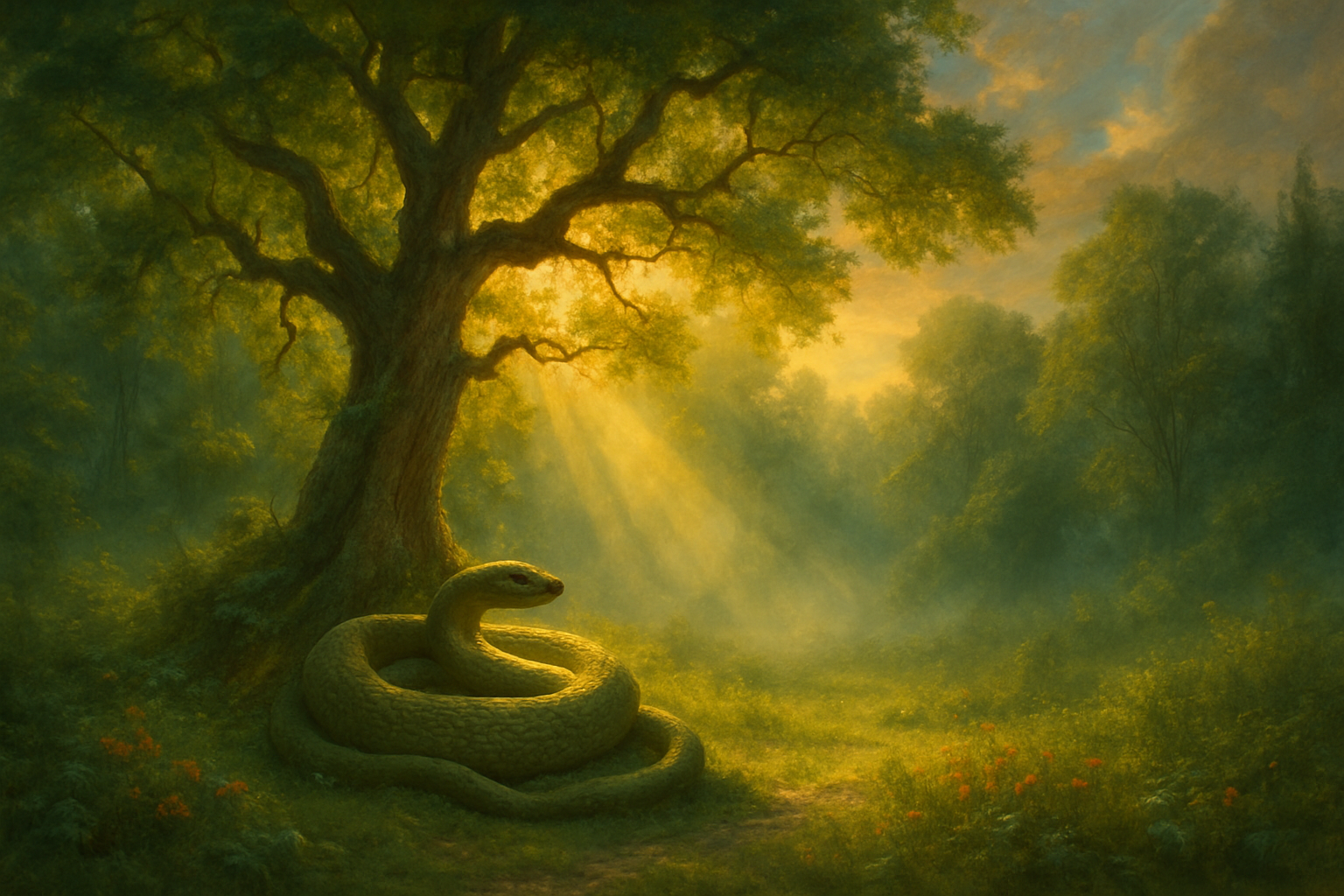
The Garden of Eden is the map of where we need to go.
Geula is the Jewish word for the world coming into its final, true form — a future when humanity knows what it has been living inside the whole time. It is not a fantasy. It is a description of where we are already going.
The Garden of Eden story is a condensed account of all of Creation. Six landmarks — the Garden, the Tree of Life, the Tree of Knowledge, the Snake, Eve, and Adam — describe a process that began in Eden and is finishing in front of you.
This is the generation equipped to read it. Simulation, source code, intelligence, network — the vocabulary humanity finally invented in the last forty years is the vocabulary the Torah has been describing reality with for three thousand. The framework and its modern translation are arriving in the same room. What used to require faith is now a recognition.
The Garden is not somewhere else and not in the past. It is the continuously rendered reality you are sitting inside right now — sustained, in this instant, by the Intelligence that wrote it. The whole story begins the moment a character notices.
The Garden is the world you are currently running inside. Trees, gravity, the breath you just took, the cursor on this page — every detail of every moment is being held in existence by an intelligence intrinsic to the system, frame by frame. There is no machine left alone to tick. An infinite consciousness rendering reality, and It is paying attention to every pixel of it.
The Garden's only design constraint is concealment by choice. The Author is present in every leaf and hidden behind every leaf at the same time. A normal life can pass through the world without anyone forcing the question. That is the point. The system was built to honor exactly one thing — your choice to recognize the One running it — and it refuses to coerce that choice in either direction.
The moment that everything changes is when the characters inside the simulation realizes it is one. Not by escaping — there is nowhere to escape to. By looking at the thing rendering and admitting some intelligence is creating it. The Garden was built for exactly that recognition.
There is no “outside the simulation.” There is only the moment the character looks up — and discovers the Author was inside the room the whole time, holding the room in existence.
The consequences are immediate, and they are the consequences that have always been there. Miracle is no longer a hard problem. It is the operator stepping into His own creation to override the usual rules. Prayer stops being a wish into the void. It is a finite character speaking directly to the Intelligence holding the world in existence, in the same instant He is holding it. He is always listening.
A nature that runs on its own is a building with no architect. A nature held in being by an Infinite mind is a workshop with the maker still in the room. The first leaves you alone in the simulation. The second tells you the room has always been full.
This is why this generation can finally hear it. Render, source, intelligence, network — the vocabulary humanity invented in the last forty years is the vocabulary the Torah has been describing reality with for three thousand. The framework and its modern translation have arrived in the same room at the same time. The recognition the Garden was built for is not theoretical any more.
Not a religious document inside the universe. The blueprint the universe was compiled from — and a witness planted in your genome to prove it, when the generation can read both.
“G‑d looked into the Torah and created the world.” In the tradition this is not poetry. It is a claim about precedence: the Torah is the schema, and physics, biology, history are instances of it. Before time, the blueprint. After time, what was written.
If that is true, the most striking implication is biological. Just as the Torah is the source for the cosmos, DNA is the source for a person. Twenty‑two Hebrew letters; twenty amino acids plus two special‑case codons. The correspondence is suggestive — and worth searching, not because it is proven, but because the Author of both would have every reason to leave it findable.
GeneSys is the search for that signature inside the text: a sequence in the Torah that, translated through the right key, becomes a real biological sequence — one that does something measurable in a body. When such a sequence is found, the consequence would be hard to overstate: the first evidence for the Torah's origin that doesn't require faith. The search is the project's research target, not a delivered finding.
This would be the kind of evidence the next century was built for. The previous one would not have known what to do with it.
The proof comes through nature, not against it. That is the pattern of the Garden. The Garden does not lift its veil; it lets the veil become transparent.
The Jewish people as a soul deployed across seventy nations. Not exiled and forgotten — sent. The mission was always the gathering.
Eve is em kol chai — mother of all life. The Eve pattern, as the framework reads it, is the Jewish people functioning as a soul distributed across the human body politic. Every place the Jews were sent, sparks of holiness were waiting to be reclaimed. The exile was not punishment with a side of waiting; it was a mission whose shape was disguised as the punishment.
Two flows run through this layer. Unrectified, impurity travels inward: the world's tumah enters Israel through the most porous Jews — the Erev Rav, the mixed multitude, the interface. Rectified — and this is the framework's claim, not the standard reading — the same channel carries kedushah outward and brings the gathered sparks home. Same people. Opposite direction.
Geula does not happen instead of the dispersal. It happens because the dispersal finally finishes its job.
Its move is temptation — a probe of how strong the will is, and whether it can be turned. When someone falls, the fall doesn't create the flaw; it exposes one that was already there, waiting to be revealed. And a flaw you can finally see is a flaw that can finally be repaired.
Start with what the serpent actually does. It tempts — which is another way of saying it tests. It leans on the will and measures whether the will holds: how strong is it, can it be turned? When the first humans give way, the move that breaks the Garden doesn't create a flaw in them — it reveals one that was already there, latent, waiting for the right pressure to draw it out. And the breaking throws the whole story into exile, which is precisely where a revealed flaw can finally be worked out. The snake is the device that surfaces what a world has to see before it can be brought home.
Once you see the mechanism, its fingerprints are everywhere. The line that leads to Moshiach is built almost entirely out of episodes that look like things went wrong: Lot and his daughters in the cave, Yehuda and Tamar by the side of the road, David through a story you would not put on a billboard. Redemption keeps arriving through the most embarrassing door in the house — on purpose.
The fall doesn't create the flaw. It reveals the one that was already waiting.
And the serpent is not a one‑time reptile. The tradition tracks it as a recurring force — the tester, the prosecutor, the one who rides in on each generation's weakest seam. Eden, then Esav, then Edom, then Rome, then the faith that grew up inside Rome from a Jewish root. Same mechanism, new costume each time.
Its most charged appearance is a Jew pushed out of the Jewish world two thousand years ago — the founder of Christianity. Set the verdict aside for a second and look only at the result: through him the Tanakh and the basic moral grammar of Sinai reached billions of people who were otherwise never going to open it. Half the planet now knows the names Avraham, Moshe, David, Yeshayahu, and carries some version of the Jewish moral imagination — because of a movement that traces back to him. The vessel was distorted almost past recognition. The cargo arrived anyway.
One traditional reading — the Arizal’s — places it precisely. He was, on that reading, a soul of Esav: Yaakov’s twin, the brother who was meant to be a partner and became the long opposition instead. A soul like that, deployed across two thousand years, could do one of two things — keep the sparks scattered, or smuggle the Tanakh out to exactly where the sparks were waiting. History is not subtle about which one happened.
And the honest reading has to name what came after him, too. Paul, most famously, pulled the movement away from nearly anything its teacher would have recognized; the parts that scandalize Jewish ears — the trinity, the deified man, the worship of a person — were grafted on later, not native to the transmission. Christianity as it stands today we reject, and there is no softening that line: no human being is G‑d.
But the spark underneath the distortion is another matter — and recovering it is the real question this pillar asks. What is the tikkun? Strip away what the centuries built on top, and the vision underneath is startlingly familiar: a G‑d you speak to directly, with no broker; mercy that goes looking for exactly the people everyone else wrote off; joy; the good point buried in every person; a faith plain enough for a child. That spark is ours, and it is getting close to the time to carry it home.
Two thousand years of redemption‑shaped longing among the nations is not an accident. It is the long, slow form of a single sentence: the sparks are coming home after being scattered to the farthest edge of Creation. The tradition even pressed a number onto this pattern, ages ago, to mark exactly where it was headed. That part the pillar keeps for the end.
Internet, intimacy, plant medicines, AI. Each delivers genuine wisdom and genuine damage from the same source. The work is not rejection — it is realignment.
The Tree of Knowledge delivered “knowledge of good and evil” in the same bite. So does the internet. So do psychedelics. So does sexuality. That is not a coincidence and it is not a metaphor. It is the same tree.
Each is a real expansion of human capacity for good. Each is doing real damage right now. The standard responses — “avoid it,” “regulate it,” or “embrace it uncritically” — all miss what the pattern is asking of us. The pattern says: these were given for a purpose. We are eating from them either way. The only question is whether the eating is aligned with the purpose or not.
Now that we know what was deployed and what was distorted, this is what we are asked to repair. In a rectified world the internet is not a slot machine for the lower self. It is the nervous system of a humanity that learns together. Cannabis and Psychedelics are not escape; they are medicine created by the Programmer to heal and grow, prescribed sparingly and held inside something. Sexuality is not consumption; it is the closest creative act humans get to. AI is not a god; it is a faint shadow of one — useful precisely because it makes the real thing easier to imagine.
We ate before we were ready. Now the world is ready.
Two messianic figures, one process. Ben Yosef does the preparing, suffering, building, fighting. Ben David does the recognizing, the kingship, the rest.
The tradition describes two messianic figures because completion is two‑staged. Moshiach ben Yosef does the work that does not look like the work — preparation, suffering, rebuilding vessels, war if it comes to that. Moshiach ben David arrives when the room is ready, and is recognized.
The history of premature messianic claims is exactly the reason this part stays restrained on this site. The right posture is to watch the process — the gathering, the witness, the rectified tools, the recognition — and let the players resolve themselves inside it. The process is more reliable than the players, and the process is unmistakably underway.
Argument is finite. What's needed now is infrastructure — tools, classrooms, immersive environments, research programs — that let the framework be experienced rather than only believed.
A physically‑scaffolded VR walkthrough of the Third Temple — a way to anticipate, in nature, what will eventually arrive without nature.
An AI trained only on Tanakh, Talmud, commentaries, and Kabbalah — answering from the framework instead of from the open internet.
The research program: search for the biological witness encoded in the Torah — and document the method openly so the result can be replicated.
An augmented‑reality overlay on ordinary life — labeling the framework as you move through it, until the labels stop being needed.
An interactive diagram of the framework — clickable, scalable, designed to be the on‑ramp for any newcomer to the project.
Short essays — Geula Drops — released as the framework lands. Read‑in‑public verification of sources, claims, predictions.
Stay close to the project. New essays, source verifications, and prototype releases as the framework lands.
No spam · only signal